CrowNet
CrowNet is a collaborative canopy and phenology tree monitoring network based on continuous digital canopy images. These images were typically derived from low-cost, off-the-shelf trail/hunting/wildlife cameras (hereafter camera traps) using their in-built time-lapse feature, which allow to use this cheap, widespread, and affordable digital camera technology to ease field monitoring implementation.
Using the time-lapse feature, daily images were acquired programmatically with the camera trap placed below the canopy and oriented upward (in case of tree canopies). Daily images are then processed to estimate canopy structure attributes (e.g. LAI, foliage cover, clumping) using consolidated image processing procedures. The phenological transition stages are then inferred from annual series of daily canopy attributes. Details of the method can be found in Chianucci et al. 2021.
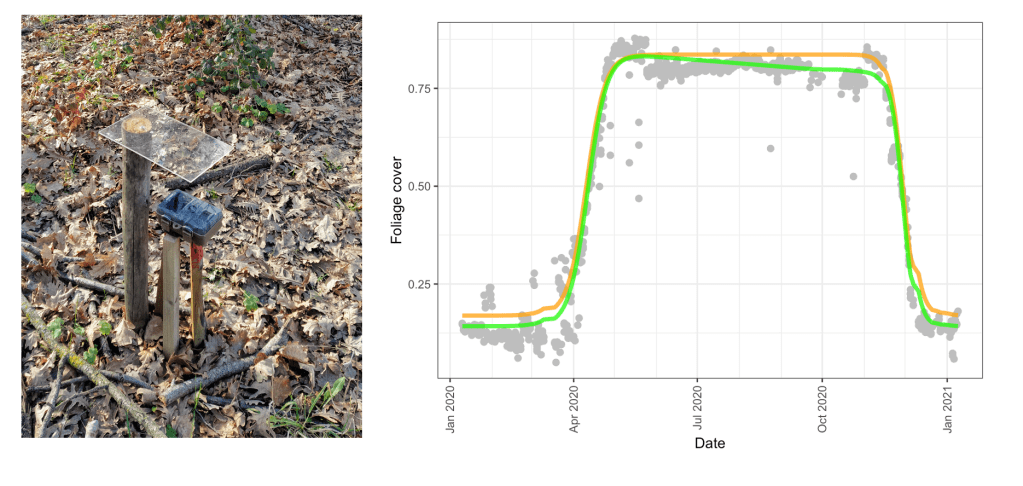
Left: a camera trap installed in an oak stand. Right: phenological transition are derived from annual canopy attributes derived from daily images. From Chianucci et al. 2021.
The purpose of CrowNet is to establish a long-term monitoring network and maintain a common data platform of high-quality canopy and phenology field observations.
You can access data available from the first CrowNet monitoring period (2022-2024) at: Chianucci, Francesco; Lenzi, Alice; Minari, Emma; Gonnelli, Marco (2025), “CrowNet: a trail-camera canopy monitoring system”, Mendeley Data, V1, doi: 10.17632/gkr667jvhx.1.
The article describing CrowNet is available at: Chianucci et al. 2025.
Chianucci F , Lenzi A Minari E, Guasti M, Gisondi S, Gonnelli M, Innocenti S, Ferrara C, Campanaro A, Ciampelli P, Cutini A, Puletti N 2025. CrowNet: a trail-camera canopy monitoring system. Agricultural and Forest Meteorology, Volume 372, 110596, https://doi.org/10.1016/j.agrformet.2025.110596.
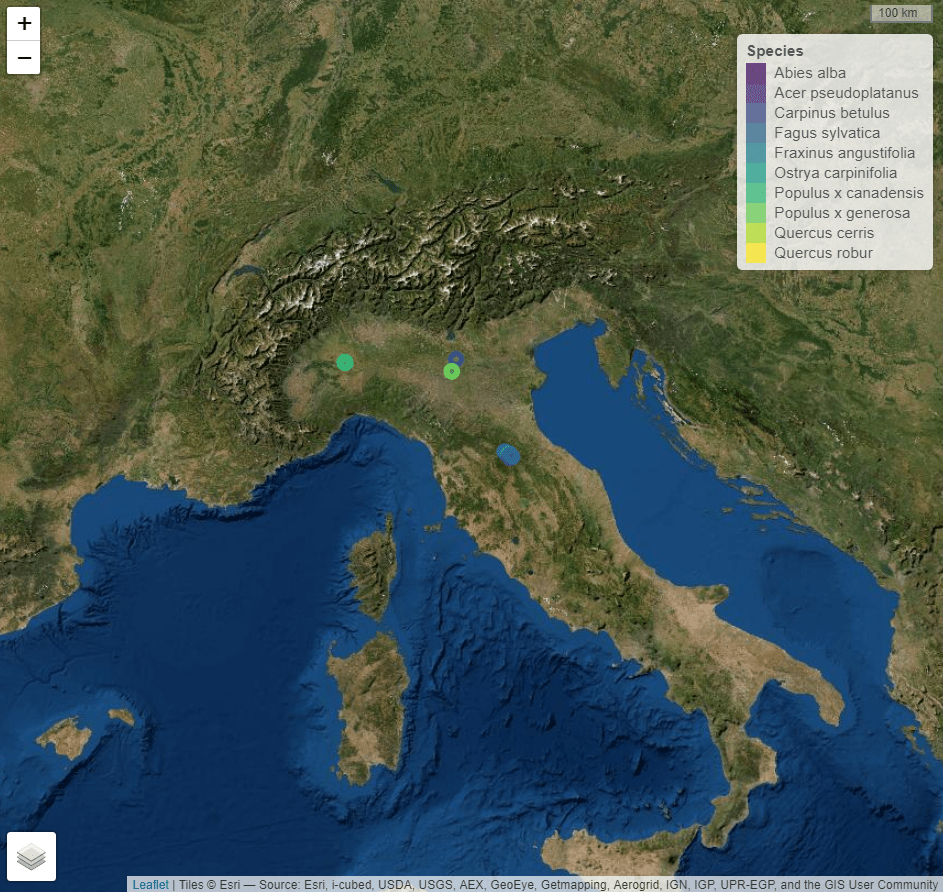
Map of sites. See the interactive map here.
The CrowNet is based on a ‘fifty-fifty’ contributing strategy:
People interested in joining the network need to supply their continuous canopy images collected from trail camera(s); this means that they act as Data provider, and therefore they oversee the provision, installation, periodic maintenance of the camera, and the downloading and transmission of the images at a solar year frequency.
The submitted images are then analysed by the network lab, to produce the annual phenological canopy series and the extraction of key phenological events, which is then shared among the network participants.
Beside the continuous images, each Data provider need to acquire ancillary information related to the vegetation type, site conditions, and stand structure required to complement canopy observations with vegetation attributes.
Field procedures for installing and setting the camera trap should follows the recommendations below:
installation_instructions_v1.0Download
Ancillary data should follow the template (with examples) attached below:
Are you interested in joining CrowNet? Contact me!