Intuitively, the arrangement of plant components in space follows specific strategies to allow vegetation to cope with their non-locomotory nature.
Indeed, the rooted existence of plants implies a directional growth, where some tissues were displayed toward light (leaves and branches), and some others towards water and nutrients (roots).
The way plants can arrange their elements in space has a long history of studies. Already Theophrastus (371-287 BC) noticed the geometric correspondence of the arrangement of the plants during their growth. Observations in this sense had been made in Pliny the Elder’s Naturalis historia (23-79 AD). Leonardo da Vinci (1452-1519) provided the first geometric description of leaves’ arrangement around the stem. Among the most recurrent functions, many plants grow following mathematical models attributable to the numerical succession of Fibonacci (1170-1250) and the related golden section, although the intuition of a relationship between phyllotaxis (from the Greek words phyllon = leaf and taxis = arrangement) and Fibonacci’s succession is due to Kepler (1571-1630).
Leaf inclination angle distribution (LAD) is a very important architectural trait to adapt plant to specific environmental conditions. Generally speaking, leaves need to find a balance between resource exploitation (e.g., light interception) and environmental stress (e.g., reduce temperature load and respiration loss). Horizontally-oriented leaves intercept more light, while vertically-oriented leaves can reduce radiation load at midday, resulting in lower thermal stress. Due to plasticity of plants, a vertical variation of leaf inclination angle distribution allows to achieve a trade-off between light harvesting and self-shading avoidance. The complexity of environmental conditions in which plant may grow and functional implications of leaf inclination angles on various plant processes imply a wide variety of leaf architecture habits. I refer to the review of Zanten et al. (2010) for a very comprehensive description of the relevance and control of leaf angle in plants.
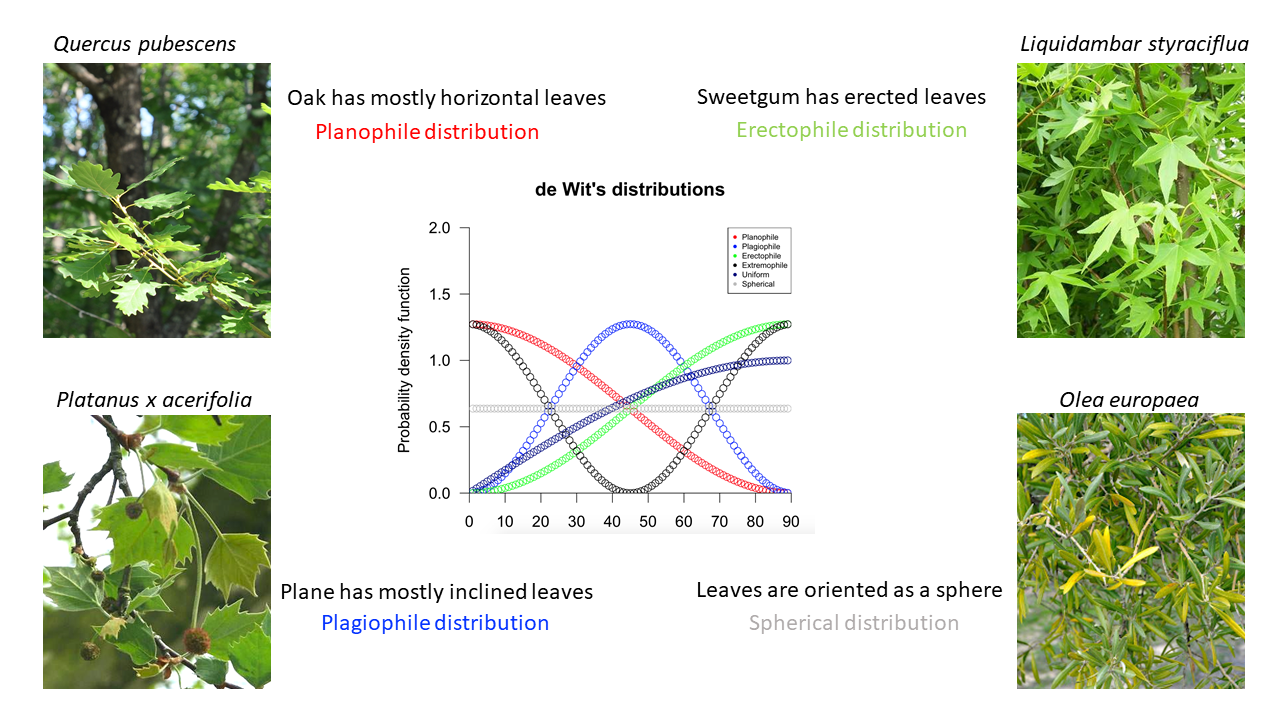
Thanks to the studies of de Wit (1965), LADs can be efficiently described by mathematical functions, which are based on the statistical distribution of the leaf inclination angles: planophile, plagiophile, erectophile, extremophile, uniform and spherical.
- For uniform canopies, the proportion of leaf angles is the same at any angle;
- planophile canopies are characterized by a predominance of horizontal leaves;
- plagiophile canopies are dominated by inclined leaves;
- erectophile canopies are dominated by vertical leaves;
- extremophile canopies are not dominated by inclined leaves;
- spherical canopies have not preferred orientation, such as the leaves are oriented as a sphere.
However, the LAD is one of the less documented attribute of plants, particularly in tree canopies. This is motivated because the direct measurement of leaf inclination angles in trees is hindered by the difficulty to access tall tree crowns. Many advances in measuring actual leaf inclination angles has been achieved about ten years ago thanks to an innovative method proposed by Ryu et al. (2010). The method (leveled photography; LP) consists in acquiring leveled images of the canopy using a digital camera from favourable (=side) viewing points. In their work, they collected side images along a vertical tree profile using a tower. Alternatively, side photographs of tree crowns can be obtained using extendable poles, ladder, nearby buildings. In addition, McNeil et al. (2016) implemented this method in unmanned aerial vehicles (UAVs).
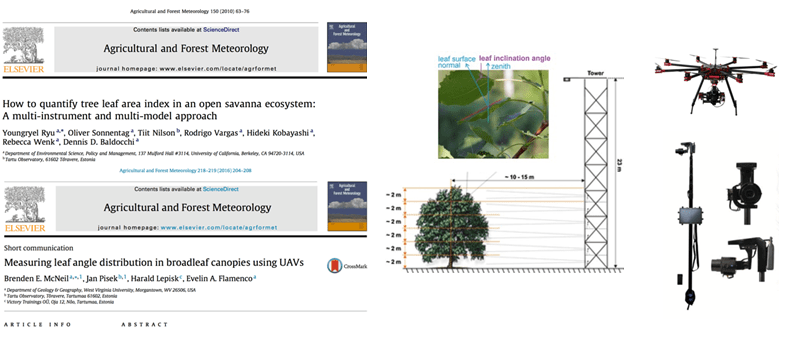
Thanks to this cheap, reliable and innovative digital canopy photographic method, in 2018 I compiled the largest global tree database of leaf inclination angles, in collaboration with Estonian colleagues (Chianucci et al. 2018). In addition, Pisek and Adamson compiled a database of 71 different Eucalyptus tree species (Pisek and Adamson 2020) using this method.
Over the last few years, strong advancements in terrestrial laser scanning processing methods allowed to develop efficient methods to measure leaf inclination angles from this active technology (Vicari et al. 2019; Stovall et al. 2021). However, the photographic LP method still represent a very effective solution, on account of its simple and fast procedures, which makes this method a ideal tool to calibrate new procedures, including those from terrestrial lidar.