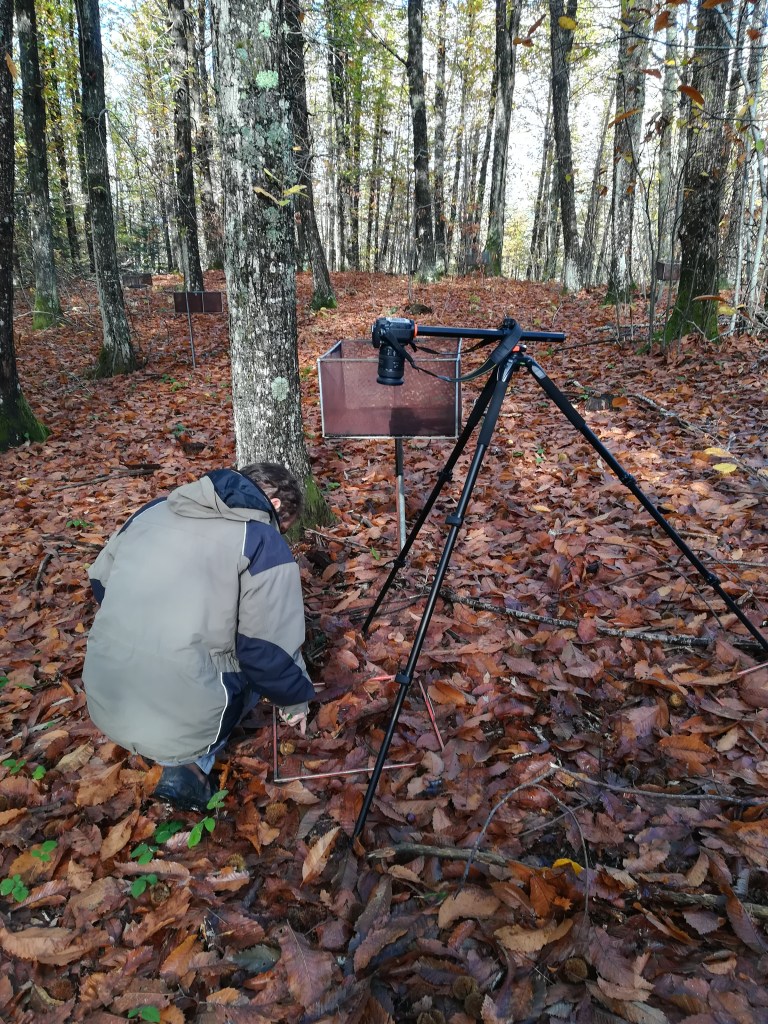
Digital photography possesses several features which makes use of the digital information suitable for retrieving information on the green components of vegetation.
As a passive sensor, the digital number is indeed an analog-to-digital measure of the intensity of light reflection of the object captured by a digital image, which can be used to calculate the spectral signature of leaves and crowns from digital images (examples with canopy photographs in Chianucci et al. 2019; Raddi et al. 2021), or to extract green vegetation from surrounding elements, which is the principle behind calculation of Vegetation Indices (examples with canopy photographs in Liu and Pattei 2013; Macfarlane and Ogden 2012). Similarly, image acquisition in diffuse sky allows maximising the contrast between canopy (as leaves have larger absorption under diffuse light) and gap pixels, which is used to calculate gap fraction from digital canopy photographs.
Mast seeding, the variable, intermittent synchronous production of large seed crop by perennial plants (Kelly and Sork 2002), is another plant phenomenon which have received an increasing interested in the last decades, as showed in the below graph.
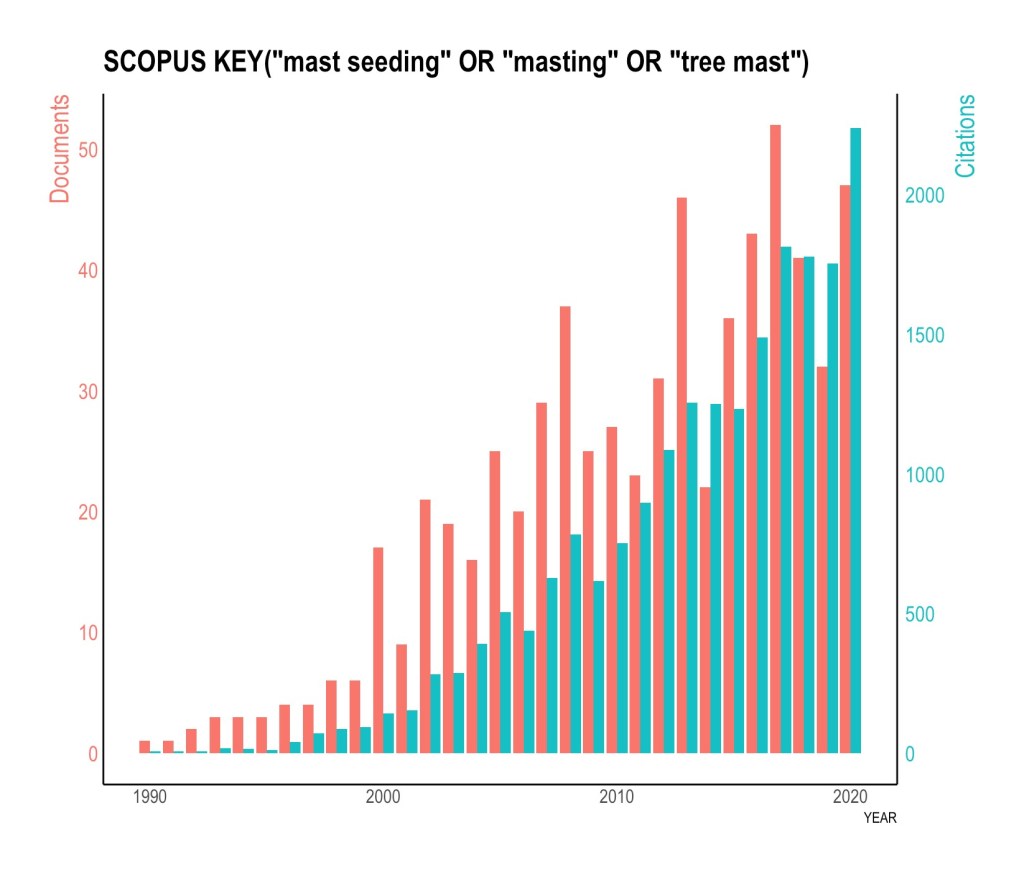
Beside the scientific interest related to this phenomenon, the main challenge in studying masting is that i) available methods to quantify masting strictly rely on field measurements of seed availability and ii) a long-term perspective is required to understand how reproduction acts during the life cycle of a tree.
In a recent article, Tattoni et al. (2021) tested use of digital photography to get an estimate of seed production at the forest floor, compared with alternative benchmarking field methods (litter-traps and ground quadrats). Results indicated that the manual counting of seed from digital images is comparable with the other more time-consuming ground methods.
Results indicate the potential of digital photography for quantifying seed production. From a practical point of view, the following challenges need to be considered for making digital photography operational for seed monitoring:
- leaves and seeds usually fall on the same period, so that the seeds can be obscured by other litter components;
- the image counting procedure is manually performed, and therefore automatic image classification procedures are needed to reduce subjectivity and time-efforts;
- the manual identification implies the count is more difficult in small-sized seed species.
While use of continuous cameras can reduce the issues above, alternative photographic approaches can overcome the limitation of floor sampling, such as orienting camera with a longer focal lens towards the crowns could allow to better identify seeds on tree branches. Overall, the study by Tattoni et al. indicated that digital photography can potentially hold a key role in future masting studies.