The total number of smartphone users worldwide have nowadays reached 4 billion users — more than half the human population (The Atlantic 2018).
Smartphone is a ubiquitous technology and a widely used source of information. It is a relatively cheap, portable, internet-enabled device featuring a variety of sensors, which can be used to collect and analyse data, for use in monitoring and research.
Smartphones have at least three key features to allow its practical implementation in canopy photography research and monitoring:
- From a camera’s point of view, the current high quality of smartphone cameras makes it possible to use them as an alternative to standard point-and-shoot cameras. Many smartphone models can also feature fisheye lenses, which allows implementing hemispherical photography in these devices; an example is given in Bianchi et al. (2017). Alternatively, the digital technology embedded in smartphones can allow to produce spherical pictures from compounding images: recently, Andis et al. (2021) used the Google Camera APP installed in a smartphone to generate spherical panoramic images from composing individual images, and applying spherical->equirectangular->polar coordinate conversion to resemble a hemispherical canopy image at higher resolution than is possible with traditional ‘physical’ photography. (Tip: read Andis’ page, which also contains a section to collect spherical panorama image).
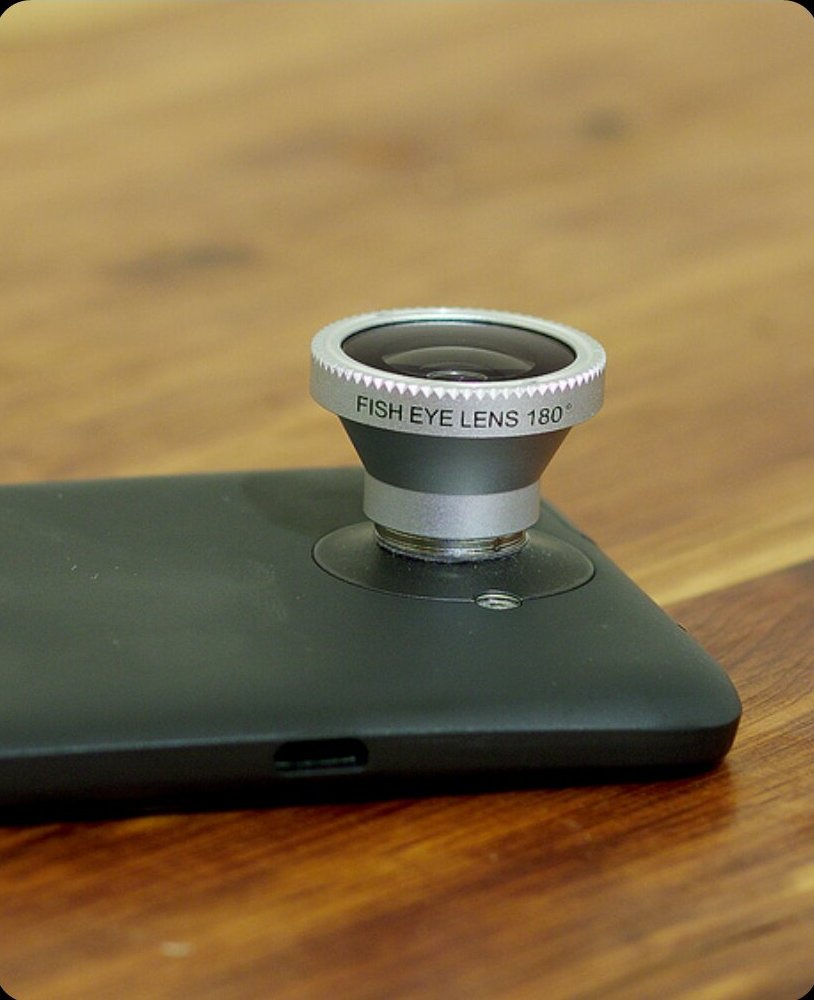
PolicyRocker15, CC BY-SA 3.0, via Wikimedia Commons.
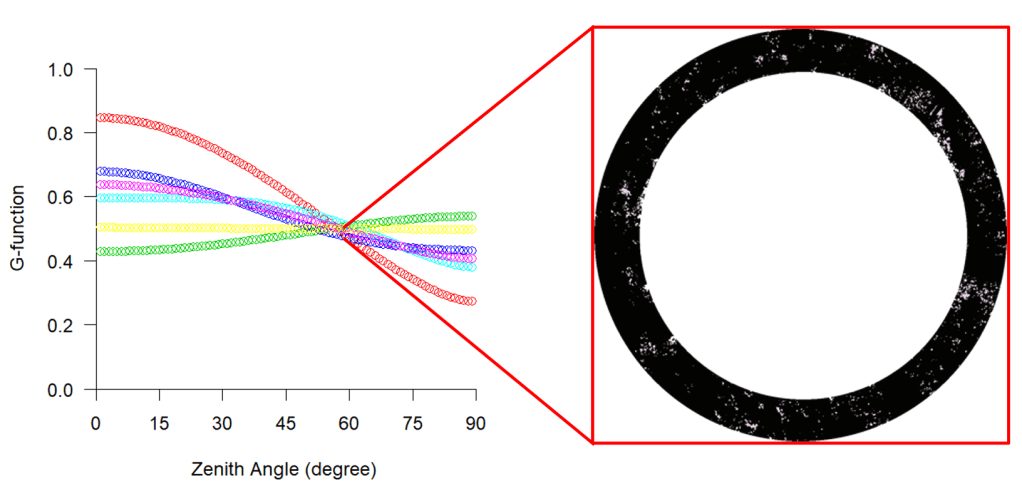
- From a software point of view, specific software packages can be designed to run on these devices (“APP”). An example in canopy photography is the PocketLAI: it allows to collect inclined images when the smartphone sensor reaches 57.5° orientation, and then a segmentation is applied to produce a binary classification, which is used to estimate LAI from classified gap fraction. This method uses an optical property of the canopy, which is insensitive to leaf inclination angle distribution at a inclined view of 1 radian (~57.5°)
Other APPs have been specifically developed for retrieving canopy structure from either downward-looking (Canopeo and Canopy Cover Free) or upward-looking (Percentagecover, HabitApp, CanopyApp and LAICanopy) images using smartphones. GLAMA is another App for calculating canopy attributes from smartphones
- From a hardware point of view, a smartphone camera can be integrated with many different device sensors, which makes it possible to e.g., measure the orientation and position of the acquired images from inertial and Global Positioning System (GPS) sensors, and allows data transmission through Wi-Fi or Bluetooth communication protocols. By connecting two smartphone terminals, Qu et al. (2016) designed an integrated measurement system, LAISmart, which provides two image segmentation options based on either the greenness index or the blue-band intensity of downward- and upward-looking smartphone images, respectively. LAI is then estimated from the gap fraction model assuming a spherical leaf angle distribution. The integrated system uses Wi-Fi to transfer data to a remote service, reducing the cost of field procedures.
From a wider point of view, smartphone technology allows instant information gathering and sharing, which can lead towards the use of smartphones as a tool for collecting photographic data and their implementation in a framework of citizen science. A recent example is provided by Schiller et al. (2021), which used plant pictures from iNaturalist, a citizen science global platform of geolocated smartphone pictures, combined with TRY, the global largest dataset of traits (Kattge et al. 2021) to retrieve global leaf traits from photographs using Convolutional Neural Networks.