Leaf angle distribution (LAD) is an important factor for describing optical features of vegetation canopies (Ross 1981).
It influences several processes such as photosynthesis, evapotranspiration, spectral reflectance and transmittance (Vicari et al. 2019).
LAD influence on radiation transmission is described by leaf projection function (also known G-function, it is the projection coefficient function of unit foliage area on a plane perpendicular to the viewing direction), which is used for indirectly leaf area index (LAI) measurement (Ross 1981).
LAD is one of the most poorly characterized parameters due to its difficulty in measuring leaf inclination angles. Several methods and instruments have been proposed, however, their use has been generally hampered by difficulties in applying them to tall and closed canopies, their unsatisfactory ability to reproduce measurements and high costs.
As alternative to direct manual measurements, Ryu et al. (2010) proposed a robust and simple leveled photographic method to measure leaf inclination angles, which was proven comparable to manual clinometer measurements (Pisek et al. (2011)).
Me and colleague Lorenzo Cesaretti have created the R package “LAD” to calculate the Leaf angle distribution (LAD) function and the G-function from measured leaf inclination angles obtained from leveled photography or other methods. Once a reliable set of leaf inclination angles measurements are taken (a minimum of 75 measurements per species are recommended by Pisek et al. (2013)), two parameters μ,ν are derived for fitting a Beta distribution, which is considered a reliable function to describe the LAD.
In order to interpret the measured distribution, the LAD package allows comparing the measured distribution against six theoretical LAD described by de Wit (1965):
In spherical canopies, the relative frequency of leaf inclination angle is the same as for a sphere;
planophile canopies are dominated by horizontally-oriented leaves;
plagiophile canopies are dominated by inclined leaves;
erectophile canopies are dominated by vertically-oriented leaves;
extremophile canopies are characterized by both horizontal and vertical leaves;
uniform canopies are characterized by equal proportion of leaf inclination angles for any angle.
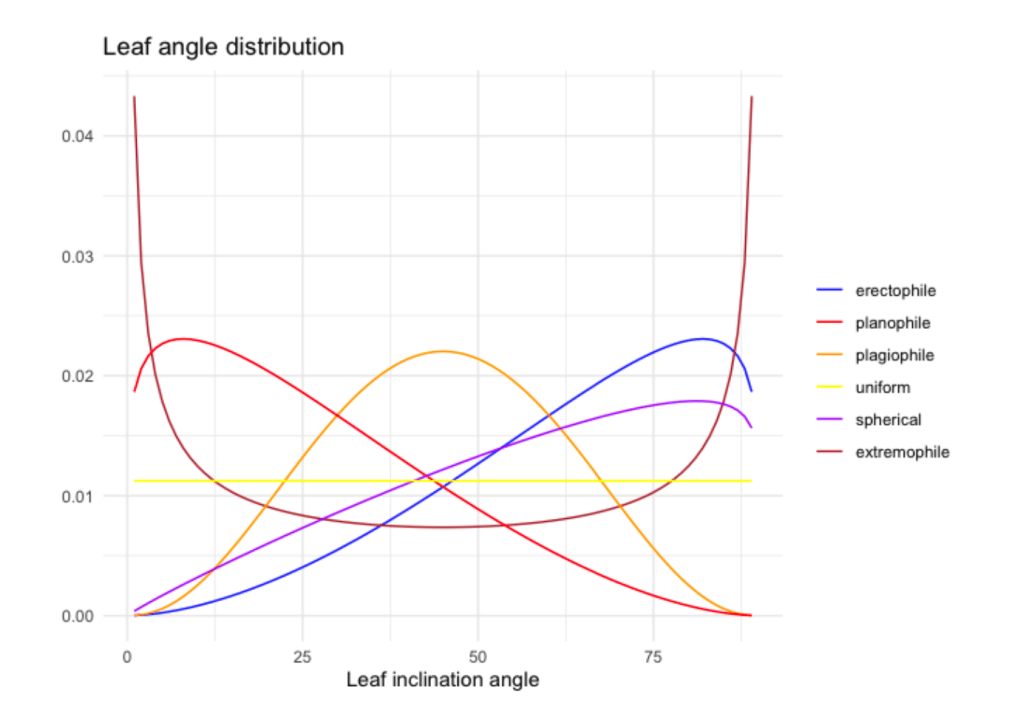
The six theoretical distribution described by de Wit (1965).
The package can be installed from CRAN:
install.packages("LAD")The R package have two key functions:
fitLAD(): it calculates both the LAD and the G-function from two-parameters Beta distribution:
calcLAD(): it calculates summary statistics, LAD, G-function and distribution type from measured leaf inclination angle.
Example:
calcLAD(Chianucci,Angle_degree,type='summary',Genus,Species)

## Joining, by = c("Genus", "Species")
## Joining, by = c("Genus", "Species")
## # A tibble: 138 x 8

##    Genus  Species         MTA    SD     N    mu    nu distribution
##  6 Acer   monspessulanum  20.1  14.8   105  4.21  1.21 planophile
##  7 Acer   negundo         59.4  17.5   114  1.68  3.26 erectophile
##  8 Acer   platanoides     26.8  16.7  1254  3.56  1.51 planophile
##  9 Acer   pseudoplatanus  33.8  17.1   102  3.44  2.07 planophile
## 10 Acer   rubrum          30.3  16.1  1001  3.98  2.03 planophile
## # ... with 128 more rows
The article describing the package is available at: Chianucci F., Cesaretti L. LAD: an R package to estimate leaf angle distribution from measured leaf inclination angles. bioRxiv 2022.10.28.513998; doi: https://doi.org/10.1101/2022.10.28.513998