Leaf Area Index can be collected in the field, using either direct or indirect optical methods (for a review, see Yan et al. 2019, Chianucci 2020).
However, in situ measurements are time-consuming and unpractical for large areas. Proximal and remotely-sensed information offers a unique way to obtain spatially-extensive mapping of LAI, from landscape to the global scale. While active sensors like LiDAR and SAR have recently considered attention for monitoring LAI (Wang et al. 2020), so far the majority of applications consider passive optical sensing (Chianucci et al. 2016; Fang et al. 2019; Xie et al. 2019).
Passive optical methods typically derive LAI from empirical equation relating LAI to some vegetation indices (VIs). The Normalized Difference Vegetation Index (NDVI) is amongst the most widely used VI in vegetation monitoring, as it is simple and can be derived from the widest array of multi-spectral sensors currently available. However, the relationship between LAI and NDVI is essentially non-linear, and sensitive to vegetation type (crop-specific), canopy conditions and density. Therefore, many conversion equations have been proposed and published in the literature, deriving from applications in different regions, on different crops, and with different sensors.
The LAIr package provides a simple tool to implement the conversion formulas available in literature, as compiled in Bajocco et al. 2022. A single function NDVI2LAI() allows to select the most suitable formula(s) by selecting those based on available vegetation and sensor attributes, and apply the conversion equation(s) to raster or numeric inputs. The next paragraphs describe in detail the methodology and the package functioning.

The package can be installed from CRAN:
install.packages('LAIr')The LAIr package features a single NDVI2LAI() function. The function allows to import an input Raster* or numeric vector and select the suitable conversion equation formula(s) based on a set of optional vegetation (category, type, name), or sensor (sensor name, platform, resolution) filtering parameters. If no arguments are not considered, the function by default implement all the available functions.
The list of all available LAI-NDVI equations have been compiled by Bajocco et al. 2022 and can be screened by typing NDVI2LAIeq, which allows to see also the available options for each filtering parameter.
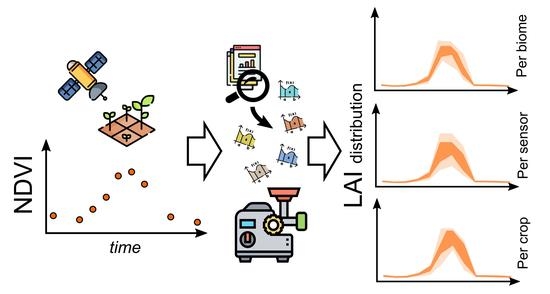
Figure from Bajocco et al. 2022. The workflow of LAI-NDVI equations available in NDVI2LAIeq.
For more info, see Bajocco et al. 2022 and the LAIr package.