Relatively few studies have considered using canopy photography to link forest structure to diversity.
Applications of canopy photographic techniques have been typically focused in the following main research domains:
Forest monitoring and inventory
Calibration (and upscaling) of remotely-sensed information
Forest model parameterisation
Relatively few studies have considered using canopy photography to link forest structure to diversity. Few examples include assessing the role of forest light environment on plant communities (Hederova et al. 2023). At another level, few studies used canopy attributes to ecologically-describe forest vegetation. Indeed, some canopy parameter like leaf angle orientation and leaf area index are rather species or vegetation specific, and therefore hold potential for ecologically-relevant applications.
In a recent study led by Anouk von Meijenfeldt, we collaborated in a research to evaluate if two most commonly used canopy photography techniques like digital cover (DCP) and hemispherical (DHP) photography can be used to ecologically characterise forest vegetation types and which attributes are more important for understory plant diversity.
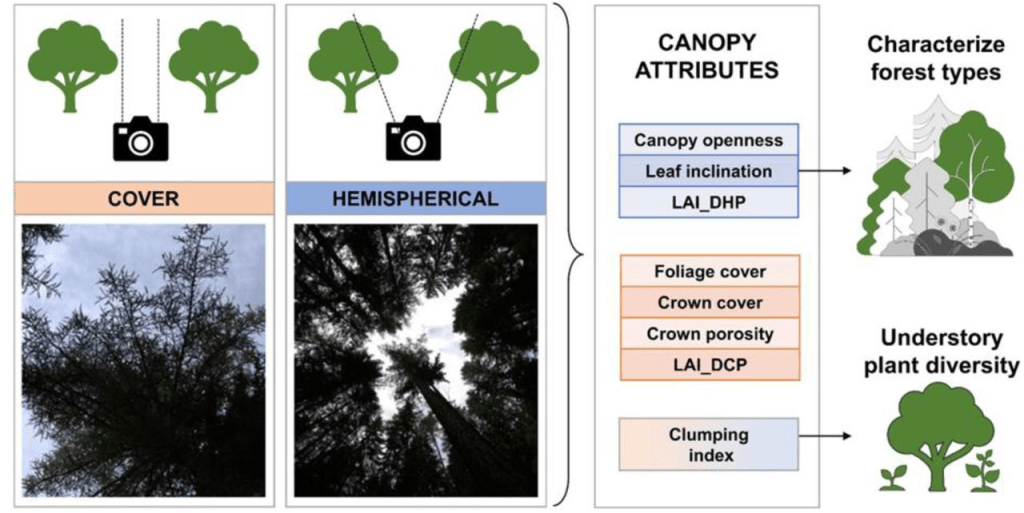
Reliability of canopy photography for forest ecology and biodiversity studies. Photo from von Meijenfeldt et al. (2025).
Results indicated that hemispherical canopy photography was most suitable to capture differences in forest types, which was best expressed by variables such as leaf inclination angle and canopy openness. This can be attributed to the largest footprint of fisheye cameras, which resulted in better representation of overall canopy structure.
In addition, foliage clumping was the most important attribute for determining plant species distribution of the understory, indicating that diverse gap structures create different microclimate conditions enhancing diverse plant species with different ecological strategies.
In general, results from this study indicate that DHP has more potential in forest ecology and biodiversity studies, while DCP could be more suited for forest inventory (Salas-Aguilar et al., 2017), remote sensing (Ryu et al. 2012) or continuous tree monitoring and phenology (Ryu et al. 2012; Chianucci et al. 2022).
This study supports the reliability of canopy photography in forest ecology and biodiversity monitoring, but also provides insight for increasing understory diversity in managed forests of high conservation value.
The article is available at: https://doi.org/10.1016/j.ecolind.2025.113293